
Almost every large enterprise has a version of the half-migrated cloud.
Three years ago the directive was absolute: shut down legacy data centers, embrace elasticity, accelerate time to market. Substantial money went into multi-year transformation contracts. Today a significant share of those initiatives have quietly stopped. Critical monolithic applications still sit in colocation facilities on extended-support licenses, while the workloads that did move generate unpredictable monthly invoices that trigger quarterly interrogations.
Faced with mounting spend and incomplete migration, leadership pulls the emergency brake: freeze new migrations, cut modernization budgets, mandate an aggressive cost review.
This is a misdiagnosis. Cloud migrations rarely stall because the cloud is too expensive or because legacy applications are too difficult. They stall because leadership conflates an architecture bottleneck with a cost-control failure. To break the deadlock, CIOs and CFOs need one diagnostic first: are you dealing with an infrastructure debt gap, or a financial feedback gap?
The Cost-Control Gap: FinOps Paralysis
A cost-control gap occurs when an organization migrates workloads using raw lift-and-shift tactics, never builds real-time financial telemetry, and reacts to the inevitable bill shock by halting operational velocity.
- Zombie instance syndrome: Legacy VMs replicated one-to-one in the cloud with static, overprovisioned allocations, paying peak-demand rates around the clock for dormant workloads.
- Disconnected feedback loops: Engineering spins up high-performance clusters with no visibility into cost impact, while finance sees the bill weeks later with no technical context attached.
- Blanket budget freezes: Because leadership cannot isolate which services deliver positive unit economics, it issues broad moratoriums on all new provisioning, strangling useful work to save marginal compute spend.
This is not a private-sector eccentricity. The Government Accountability Office has documented the same failure across federal agencies for years, first reporting that agencies used inconsistent data to calculate cloud spending, were unclear which costs they were required to track, and had difficulty systematically tracking savings at all. GAO concluded that reported spending and savings figures were likely inaccurate as a result, and its June 2026 review of federal cloud procurement shows the finding persisting. Cost tracking sits alongside cybersecurity, procurement, and workforce as one of four standing challenges GAO has identified in federal cloud adoption.
Consider what that means. Organizations spending at this scale often cannot answer, with evidence, whether the migration saved money. A budget freeze imposed on that evidentiary base is not financial discipline. It is a guess wearing a spreadsheet.
The root cause is treating cloud cost as an accounting reconciliation problem rather than an architectural runtime metric. When cost governance operates as a retroactive audit instead of automated policy, it becomes an engine of operational paralysis.
The Architecture Bottleneck: The Coupling Trap
An architecture bottleneck occurs when an organization tries to move mission-critical systems without addressing the dependencies, sovereignty boundaries, and proprietary lock-in that tie those applications to static infrastructure.
- Proprietary cloud traps: Applications rewritten onto vendor-specific managed queues, document stores, and identity services, making portability impractical and creating egress penalties on the way out.
- Stateful monolith gridlock: Core transactional systems with undocumented database couplings and synchronous batch jobs that cannot tolerate cloud network latency or ephemeral container environments.
- Policy hardcoded in the pipe: Compliance, security, and access controls written into static infrastructure scripts rather than executing dynamically across distributed domains.
The root cause here is treating cloud providers as permanent real estate rather than ephemeral execution substrates. Architect for one specific vendor instead of building a decoupled control plane, and modernization simply trades on-premises technical debt for cloud-native lock-in. The bill changes. The rigidity does not.
The Diagnostic Matrix: Breaking the Migration Deadlock
Before issuing another freeze or signing another refactoring contract, place each stalled workload on two axes: architectural agility, and financial visibility. Four positions emerge.
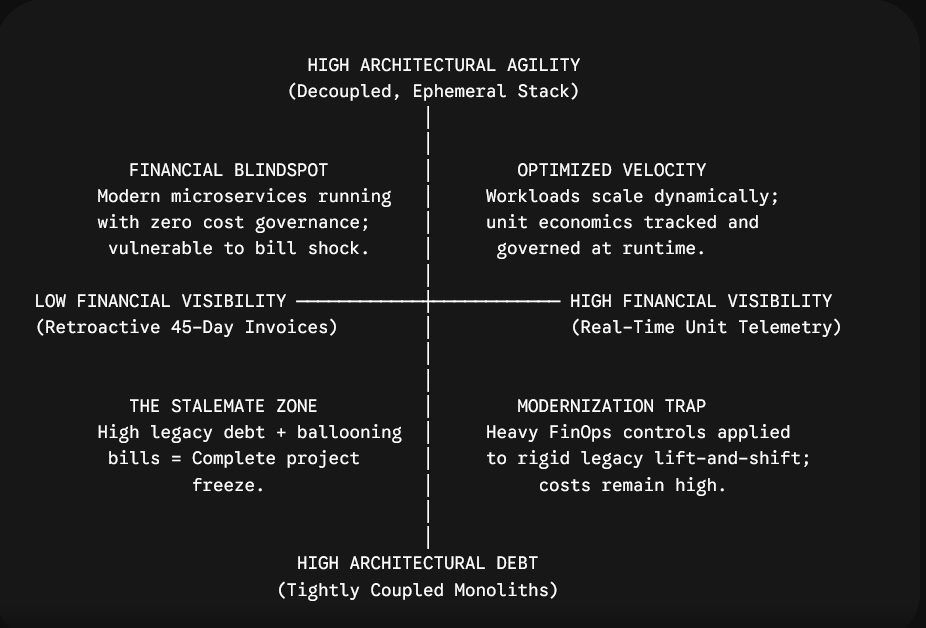
- Financial blindspot (high agility, low financial visibility): modern microservices running with effectively zero cost governance. Architecturally healthy, fully exposed to bill shock.
- Optimized velocity (high agility, high financial visibility): workloads scale dynamically and unit economics are tracked and governed at runtime. Target state.
- The stalemate zone (high architectural debt, low financial visibility): heavy legacy debt plus ballooning invoices, resolved by freezing the project outright. This is where most stalled programs actually sit.
- Modernization trap (high architectural debt, high financial visibility): rigorous cost controls applied to a rigid lift-and-shift estate. You can now see precisely how much the wrong architecture costs, and the number does not move.
The modernization trap deserves particular attention, because it is what a successful cost-governance initiative looks like when the underlying architecture was never addressed. Perfect visibility into an immovable cost is not progress. It is a well-instrumented stalemate, and it is the same pattern we described in data gaps and visualization gaps.
Remediating the Stalemate: The Sky Computing Stance
Breaking out of migration paralysis means replacing the binary choice between lifting and shifting everything and freezing the budget. Three moves.
Shift policy and identity above the infrastructure. Stop re-engineering security policy for every individual provider. As established in the Sky Computing framework, treat cloud infrastructure as an ephemeral compute tier and embed sovereignty, access control, and compliance rules into a unified, vendor-neutral identity and trust fabric. Policy has to execute as runtime logic, not as proprietary configuration.
Move from blanket cuts to automated runtime limits. Cost governance cannot live in spreadsheets. Deploy automated controls at the gateway layer that enforce budget and instance boundaries in real time. If a non-production cluster exceeds utilization thresholds or runs outside business hours, the system should throttle or terminate it programmatically, removing the need for a bureaucratic approval queue. This is the same principle as measuring governance latency rather than compliance: controls that execute at machine speed beat controls that wait for a meeting.
Decouple data placement from compute execution. Monoliths often stall because moving the compute breaks access to centralized databases. Abstract the data layer and govern placement independently from application compute, and lightweight services can run on premises, hybrid, or across multiple providers without exorbitant egress penalties or sovereignty exposure. This depends on knowing where your data actually lives, which is the same binding constraint we identified in post-quantum migration, where the hard part turns out to be inventory gaps rather than algorithms.
The VeriTech Takeaway
Cloud migration stalemates are not an indictment of cloud technology. They are the predictable result of running a 2010s lift-and-shift strategy into 2026 economic realities.
If your transformation has ground to a halt, stop debating whether to double down or retreat to the data center. Start by diagnosing whether the barrier is an un-architected application dependency or an un-governed cost pipeline. Until you decouple your operational control plane from your infrastructure provider, you will keep paying premium cloud prices for legacy enterprise friction.
SKY Operations was built to govern data, identity, and policy above the infrastructure layer, which is what makes workload placement a decision rather than a migration project. Our cloud consulting practice works the diagnostic with your architecture and finance leads together, because the answer usually sits between them. If you have a workload that has been stuck in review for more than two quarters, bring us the stalled workload and we will help you place it on the matrix.
VeriTech Consulting is a Service-Disabled Veteran-Owned Small Business. References to government organizations, published audits, and policy guidance are for analytical context only and do not imply endorsement by any federal department or agency.

